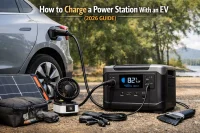


Portable power stations have become essential emergency tools for homeowners. Whether you’re dealing with a winter storm, a summer blackout, or a grid outage caused by extreme weather, a reliable battery power station can keep your essentials running without the noise, fumes, or maintenance of a gas generator. In 2026, power stations are safer, more powerful, and more affordable than ever — with models capable of running refrigerators, medical devices, sump pumps, and even small heaters.
This guide breaks down the best portable power stations for emergency use in 2026, what features matter most, and how to choose the right unit for your home.
Why Portable Power Stations Are Ideal for Emergencies
Portable power stations offer several advantages over gas generators:
1. Safe for Indoor Use
No carbon monoxide. No fumes. No ventilation required.
2. Silent Operation
Perfect for apartments, townhouses, and nighttime use.
3. Zero Maintenance
No oil changes, spark plugs, or fuel stabilizer.
4. Instant Start
Just press a button — no pull cord or warm‑up time.
5. Solar‑Ready
Most units support solar charging, giving you renewable power during long outages.
6. Battery Chemistry Improvements
Modern LFP (LiFePO₄) batteries last 3,000–6,000 cycles and are far safer than older lithium chemistries.
For emergency preparedness, portable power stations are the most flexible and homeowner‑friendly backup solution available.
Best Portable Power Stations for Emergency Use (2026 Picks)
Below are the top models based on capacity, output, safety, reliability, and real‑world emergency performance.
1. Anker SOLIX F3800 Plus — Best Whole‑Home Emergency Backup
Capacity: 3.84–26.9 kWh (expandable)
Output: 6,000W (12,000W with two units)
Battery Type: LFP
Best For: Whole‑home backup, refrigerators, sump pumps, medical devices, EV charging
The Anker SOLIX F3800 Plus is the most capable portable power station for emergency use in 2026. With massive expandable capacity and high output, it can power nearly an entire home during an outage — including large appliances and 240V loads.
Why it’s the best:
Supports 240V appliances
Extremely long battery lifespan
Fast solar + AC charging
Works with transfer switches and smart panels
Ideal for multi‑day outages
This is the closest alternative to a home battery system without permanent installation.
2. EcoFlow Delta Max 1600 — Best Mid‑Size Emergency Power Station
Capacity: 1.6–6 kWh (expandable)
Output: 2,000W (2,800W X‑Boost)
Battery Type: NCM
Best For: Refrigerators, CPAP machines, lights, routers, sump pumps
The Delta Max is one of the most versatile emergency power stations. It offers strong output, fast charging, and excellent solar compatibility.
Why homeowners love it:
Powers most household appliances
Expandable capacity
Fastest AC charging in its class
Great balance of price and performance
Perfect for homeowners who want reliable backup without going oversized.
3. Yoshino B4000 SST — Best Solid‑State Emergency Power Station
Capacity: 2,000Wh
Output: 3,000W surge
Battery Type: Solid‑state lithium
Best For: Medical devices, electronics, small appliances
Solid‑state batteries are safer, lighter, and more stable than traditional lithium cells. The Yoshino B4000 SST is one of the first mainstream solid‑state power stations and excels in emergency reliability.
Why it stands out:
Ultra‑safe battery chemistry
Lightweight for its capacity
Wireless charging pads
Excellent for indoor emergency use
Ideal for families who prioritize safety and portability.
4. Goal Zero Yeti 700 (6th Gen) — Best Compact Emergency Unit
Capacity: 700Wh
Output: 120V AC
Battery Type: LFP
Best For: Phones, laptops, routers, LED lights, CPAP
The Yeti 700 is a compact, durable emergency power station perfect for short outages or essential electronics.
Why it’s a top pick:
Extremely reliable
Rugged build quality
Safe LFP battery
Great for small apartments
A must‑have for basic emergency preparedness.
5. EcoFlow River 2 Max — Best Budget Emergency Power Station
Capacity: 512Wh
Output: 500W
Battery Type: LFP
Best For: Phones, routers, lights, small devices
The River 2 Max is one of the most affordable LFP power stations with fast charging and long cycle life.
Why it’s great for emergencies:
Charges from 0–100% in about an hour
Lightweight and portable
Long battery lifespan
Perfect for communication devices and lighting
Ideal for homeowners who want a reliable backup option without spending much.
How to Choose the Right Emergency Power Station
1. Capacity (Wh or kWh)
500–1,000Wh: Phones, routers, lights
1–2 kWh: Refrigerators, CPAP, small appliances
2–4 kWh: Sump pumps, freezers, multiple appliances
4–10+ kWh: Whole‑home emergency backup
2. Output (W)
Make sure the unit can handle your largest appliance’s startup surge.
3. Battery Chemistry
LFP: Best for longevity and safety
Solid‑state: Best for portability and stability
NCM: Higher energy density but shorter lifespan
4. Solar Input
MPPT controllers allow efficient solar charging during long outages.
5. Expandability
Some units allow extra batteries or parallel connections.
Real‑World Emergency Runtime Examples
1,000Wh Power Station
Refrigerator: 8–12 hours
CPAP: 2–3 nights
Wi‑Fi + lights: 1–2 days
2,000Wh Power Station
Refrigerator: 20–30 hours
Sump pump: 6–10 hours intermittent
Microwave: 1–2 hours total use
4,000Wh+ Power Station
Multiple appliances: 1–2 days
Whole‑home essentials: 12–24 hours
With solar: multi‑day autonomy
Final Takeaway
Portable power stations are the most flexible, safe, and homeowner‑friendly emergency backup solution in 2026. Whether you need to keep your refrigerator running, power medical devices, or maintain communication during an outage, there’s a model that fits your needs and budget.
For most homeowners:
Anker F3800 Plus is the best whole‑home backup
EcoFlow Delta Max is the best mid‑range choice
Yoshino B4000 SST is the safest solid‑state option
Goal Zero Yeti 700 is perfect for essentials
River 2 Max is the best budget pick
A reliable power station turns a blackout into a manageable inconvenience — and in 2026, they’re more capable than ever.