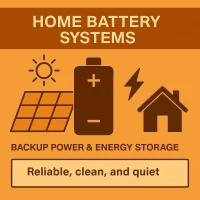



Home battery systems have become one of the most important home‑energy upgrades of 2026. As outages increase, electricity prices fluctuate, and more homes adopt solar, batteries now serve as the backbone of modern residential energy. They store electricity, power your home during blackouts, reduce peak‑hour costs, and help you control when and how you use energy. With new chemistries like advanced LiFePO₄ and emerging sodium‑ion options, home batteries are safer, longer‑lasting, and more affordable than ever.
This guide breaks down how home battery systems work, why they matter, and what homeowners should understand before investing in one.
What a Home Battery System Actually Does
A home battery system stores electricity for later use. That electricity can come from:
Solar panels
The electrical grid
A generator
An EV with bidirectional charging (V2H)
Once stored, the battery can power your home during outages or help you avoid expensive peak‑hour electricity.
Core Functions
Backup power: Keeps lights, appliances, and critical loads running during outages.
Load shifting: Charge when electricity is cheap, discharge when it’s expensive.
Solar optimization: Store excess solar instead of sending it back to the grid.
Energy independence: Reduce reliance on utilities and improve resilience.
Home batteries have become central to energy‑independent homes, especially as demand for storage surges in 2026. 1
How Home Battery Systems Work
A modern home battery system includes several key components that work together to store and deliver energy.
1. The Battery Pack
This is the energy storage unit, measured in kilowatt‑hours (kWh).
Most 2026 systems use LiFePO₄ (LFP) chemistry for long cycle life and safety, though sodium‑ion is emerging as a lower‑cost option. 2
2. The Inverter or Hybrid Inverter
Converts DC battery power into AC electricity for your home.
Hybrid inverters also manage solar input, grid power, and generator integration.
3. The Battery Management System (BMS)
Monitors temperature, voltage, and health to keep the battery safe and efficient.
4. The Transfer Switch or Backup Gateway
Automatically switches your home to battery power during an outage.
5. Monitoring Software
Lets you track usage, solar production, battery state of charge, and energy flow in real time.
Together, these components create a seamless system that can power your home automatically when needed.
Why Home Battery Systems Matter in 2026
Home batteries are no longer niche—they’re becoming standard for modern homes. Several trends are driving this shift:
1. Rising Outages and Grid Instability
Over 70 million Americans experienced significant outages in recent years, with average duration reaching eight hours or more. 3
Batteries provide instant, silent backup power.
2. Solar Adoption Is Surging
More homeowners want to store their own solar energy instead of exporting it at low rates.
Solar + battery systems are now one of the most popular home upgrades. 4
3. Time‑of‑Use Electricity Pricing
Utilities increasingly charge more during peak hours.
Batteries let you avoid those rates by discharging when electricity is expensive.
4. Energy Independence & Resilience
Batteries give homeowners control over their energy—especially important during storms, heat waves, and rolling blackouts.
5. New Battery Chemistries
Advanced LFP and sodium‑ion batteries offer longer life, better safety, and lower costs. 2
How Home Batteries Work With Solar
Solar panels generate electricity during the day, but most homes use the most energy in the morning and evening. Without a battery, excess solar is sent back to the grid—often at low compensation rates.
With a battery:
Excess solar charges the battery
The battery powers your home at night
You reduce or eliminate grid usage
You maintain power during outages
This combination is becoming the new standard for residential energy systems. 4
Whole‑Home vs. Partial‑Home Backup
Home battery systems can be configured in two main ways:
Whole‑Home Backup
Powers your entire home during an outage.
Requires a larger battery bank (20–40 kWh) and a high‑capacity inverter.
Partial‑Home or Essential Loads Backup
Powers only critical circuits, such as:
Refrigerator
Lights
Outlets
Wi‑Fi
Furnace or heat pump
Medical devices
This setup is more affordable and still covers most needs.
Battery Chemistry: LFP vs. Sodium‑Ion
LiFePO₄ (LFP)
3,000–6,000 cycles
Excellent thermal stability
Long lifespan
Most common in 2026 systems
Sodium‑Ion (Na‑ion)
Lower cost
Better cold‑weather performance
Slightly lower energy density
Emerging in 2026 as a budget‑friendly option 2
Costs, Incentives & Value
Home battery systems vary widely in price depending on size and configuration.
Typical 2026 Costs
$8,000–$20,000 for a single battery system
$15,000–$40,000 for whole‑home backup
30% federal tax credit applies to most systems 3
Long‑Term Value
Lower electricity bills
Protection during outages
Better solar utilization
Increased home value
Is a Home Battery System Right for You?
A home battery system is especially valuable if you:
Experience frequent outages
Have solar panels or plan to install them
Live in an area with time‑of‑use pricing
Want energy independence
Rely on medical or critical devices
Work from home
Own an EV and want future V2H capability
Final Takeaway
Home battery systems are becoming essential for modern homes. They provide backup power, reduce energy costs, optimize solar, and increase resilience. With new chemistries, better inverters, and smarter software, 2026 systems are safer, more capable, and more affordable than ever. Whether you want energy independence, outage protection, or better solar utilization, a home battery system is one of the most impactful upgrades you can make.