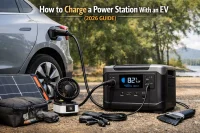



Using an EV to charge a portable power station is one of the most flexible ways to build a mobile or off‑grid power setup. Your EV becomes a giant rolling battery, and your power station becomes the bridge between that battery and your devices, tools, or small appliances. In 2026, more EVs support vehicle‑to‑load (V2L) and high‑output 12V systems, making EV‑to‑power‑station charging easier and safer than ever—if you do it correctly.
This guide walks you through every practical way to charge a power station from an EV, the pros and cons of each method, and clear step‑by‑step instructions so you don’t overload your car or your gear.
The Three Main Ways to Charge a Power Station From an EV
There are three realistic, safe methods most people will use:
Using the EV’s 12V outlet (cigarette lighter style)
Using a pure sine wave inverter connected to the EV’s 12V system
Using a factory V2L / AC outlet built into the EV
Each has different power limits, speeds, and ideal use cases.
1. Charging via the EV’s 12V Outlet
This is the simplest and slowest method—but also the most universal.
What You Need
A power station with a 12V car charging input
The included 12V car charging cable (usually barrel plug or proprietary)
An EV with a 12V accessory outlet (often 10–15A fused)
Typical Power
Most 12V outlets are limited to 120–180W (10–15A at 12V).
That means:
A 300Wh power station: ~2–3 hours to charge
A 1,000Wh power station: 6–10+ hours to charge
Step‑by‑Step
Turn the EV on or into “ready” mode
This ensures the high‑voltage battery keeps the 12V system topped up.
Plug the 12V cable into the EV’s 12V outlet
Make sure the plug is fully seated.
Connect the other end to the power station’s 12V input
Select “car” or “DC input” mode if required.
Confirm charging on the power station display
You should see 80–150W input in most cases.
Monitor for heat and time
Feel the plug occasionally; it should be warm at most, never hot.
Best For
Topping up small to mid‑size power stations
Charging while driving
Slow, steady charging during road trips or camping
2. Charging via a 12V Inverter Connected to the EV
This method uses a pure sine wave inverter connected directly to the EV’s 12V battery or high‑current 12V posts, then plugs the power station into the inverter’s AC outlet. It’s more powerful than the 12V outlet, but must be done carefully.
What You Need
A pure sine wave inverter (typically 300–1,000W for this use)
Properly sized fused cables (often 4–8 AWG for 300–600W)
A power station with an AC charging brick or AC input
An EV with accessible 12V battery terminals or jump posts
Power Limits
Most EV 12V systems can safely support 300–500W continuous without stressing components, as long as the car is in “ready” mode. Going higher is possible in some models, but it’s not something to push casually.
Step‑by‑Step
Check your EV manual for 12V limits
Look for accessory or jump‑start guidance and fuse ratings.
Mount the inverter in a ventilated, secure location
Avoid engine bay heat; trunk or frunk with airflow is better.
Connect the inverter to the 12V battery or jump posts
Red to positive, black to negative.
Use a fuse or breaker close to the battery.
Turn the EV on / into “ready” mode
This keeps the DC‑DC converter active.
Turn on the inverter
Confirm it powers up without alarms.
Plug the power station’s AC charger into the inverter
The power station will now charge from the inverter’s AC output.
Monitor input wattage on the power station
If your charger pulls 300W, make sure the inverter and EV can handle it.
Check for heat and noise
Inverter fans will run; cables should not be hot to the touch.
Best For
Faster charging than the 12V outlet
Mid‑size to large power stations (500–2,000Wh)
Van life, overlanding, and off‑grid EV setups
3. Charging via Built‑In V2L or Factory AC Outlets
Many 2026 EVs now offer vehicle‑to‑load (V2L) or built‑in AC outlets (120V, sometimes 240V). This is the cleanest, most powerful way to charge a power station from an EV.
What You Need
An EV with V2L port or built‑in AC outlet
A power station with AC input
The standard AC charging cable or brick
Typical Power
Many V2L systems: 1,500–3,600W available
Power station AC input: 300–1,500W depending on model
You’ll usually be limited by the power station’s AC input, not the EV.
Step‑by‑Step
Enable V2L or AC outlet mode in the EV
Some cars require a menu toggle or key adapter.
Plug the power station’s AC charger into the EV’s outlet
Treat it like plugging into a wall at home.
Confirm charging on the power station display
You might see 500–1,500W input on larger units.
Set any output limits in the EV (if available)
Some EVs let you cap V2L power or set a minimum state of charge.
Monitor EV state of charge
Remember: you’re draining the EV battery to fill the power station.
Best For
High‑capacity power stations
Fast charging in camp or at a job site
Whole‑camp or whole‑van power setups
How Much EV Range Are You “Spending”?
A simple rule of thumb:
If your EV averages 0.25–0.30kWh per mile,
And you send 1kWh into a power station,
You’ve effectively “spent” 3–4 miles of range.
So:
Charging a 1,000Wh power station from 20% to 100% might cost you 10–15 miles of EV range, depending on losses.
Charging a 2kWh unit could cost 20–30 miles.
This is usually worth it for camping, tools, or backup power—but it’s good to be conscious of the trade.
Safety & Best Practices
Always keep the EV in “ready” mode when drawing significant power.
Use pure sine wave inverters only for AC charging.
Fuse everything near the battery when using direct 12V connections.
Avoid maxing out ratings—run at 50–70% of outlet or inverter limits for longevity.
Ventilate inverters and power stations; they generate heat under load.
Watch your EV’s state of charge—don’t strand yourself off‑grid.
Final Takeaway
Charging a power station from an EV turns your car into a flexible, mobile power hub. Whether you use a simple 12V outlet, a properly wired inverter, or a factory V2L port, the core idea is the same: you’re moving energy from your EV’s big battery into a portable, versatile power station you can take anywhere.