


Choosing the right power station size is one of the most important decisions for camping, road trips, home backup, and EV travel. The challenge is that power stations list two major numbers—watts (W) and watt‑hours (Wh)—and both matter in different ways. Watts determine what you can run. Watt‑hours determine how long you can run it. Once you understand these two numbers, sizing a power station becomes simple and predictable.
This guide breaks down wattage, runtime math, inverter limits, surge power, and real‑world use cases so you can confidently choose the right size for your needs.
Understanding Watts vs. Watt‑Hours
Watts (W): How Much Power a Device Needs
Watts measure the instant power draw of a device.
A 1,500W induction cooktop needs a power station with a 1,500W+ inverter.
A 60W laptop charger needs only a small unit.
If your device’s wattage is higher than the inverter rating, it won’t run at all.
Watt‑Hours (Wh): How Long a Power Station Can Run Something
Watt‑hours measure battery capacity.
A 1,000Wh power station can theoretically run a 100W device for 10 hours.
Real‑world runtime is usually 85–90% of the rated capacity due to inverter losses.
The Simple Runtime Formula

The 0.85 factor accounts for inverter efficiency.
Inverter Size: What You Can Actually Run
The inverter determines the maximum wattage the power station can output at once.
Common Inverter Sizes
300–600W — phones, laptops, fans, LED lights
1,000–1,200W — mini fridges, projectors, small appliances
1,500–2,400W — induction cooktops, kettles, power tools
2,400–3,600W — full kitchen setups, heaters, RV gear
Surge Power
Many appliances spike at startup.
A 1,000W blender may surge to 1,500W.
A fridge may surge to 600–800W.
Choose a power station with a surge rating at least 1.5× your device’s wattage.
How Much Capacity Do You Actually Need?
Capacity determines runtime. Here’s what different sizes can realistically power.
300–600Wh (Small)
Best for:
Phones
Cameras
Fans
LED lights
Laptops
Typical runtimes:
Laptop (60W): 4–7 hours
Fan (10W): 20–40 hours
700–1,200Wh (Medium)
Best for:
Weekend camping
Mini fridges
Projectors
CPAP machines
Typical runtimes:
Mini fridge (60W): 10–15 hours
CPAP (40W): 15–20 hours
1,500–2,400Wh (Large)
Best for:
Cooking appliances
Heated blankets
Power tools
Multi‑day camping
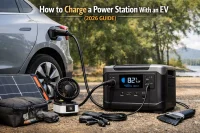
Emergency EV charging
Typical runtimes:
Induction cooktop (1,500W): 1–1.5 hours
Heated blanket (45W): 30–40 hours
EV Level 1 charging: 6–10 miles of range
3,000Wh+ (Extra‑Large)
Best for:
Full off‑grid setups
RVs
Home backup
Multi‑appliance use
Typical runtimes:
Refrigerator (100W): 20–25 hours
Microwave (1,000W): 2–3 hours total cook time
Sizing for Camping, Road Trips & EV Travel
For Tent Camping
Recommended: 700–1,200Wh
Powers:
Fans
Lights
Phones
Laptops
Small cooking gear
For EV Camping
Recommended: 1,500–2,400Wh
Powers:
Heated blankets
Induction cooktops
Electric coolers
Projectors
Fans
For EV Emergency Charging
Recommended: 2,000–4,000Wh
Adds:
6–10 miles of range with a Level 1 charger
Enough to reach the next station
For Home Backup
Recommended: 3,000–6,000Wh
Powers:
Fridge
Lights
Wi‑Fi
Fans
Small appliances
Solar Input: The Secret to Unlimited Runtime
Solar input determines how fast you can recharge off‑grid.
Recommended Solar Pairings
200W panel → weekend camping
400W panel → multi‑day trips
600–1,200W panels → full off‑grid setups
Real‑World Solar Output
A “200W” panel typically produces 120–160W in good sun.
Why Solar Matters
With enough solar, a 1,000–2,000Wh power station can run indefinitely for camping or road trips.
Step‑by‑Step: How to Choose the Right Size
1. List the devices you want to run
Include wattage for each.
2. Add up the maximum simultaneous wattage
This determines inverter size.
3. Estimate daily watt‑hour usage
Multiply each device’s wattage by the hours you’ll use it.
4. Choose a power station with 20–30% extra capacity
This accounts for inverter losses and unexpected usage.
5. Add solar if you need multi‑day power
Solar extends runtime dramatically.
Final Takeaway
Choosing the right power station size comes down to two numbers:
Watts → what you can run
Watt‑hours → how long you can run it
For most people:
700–1,200Wh is perfect for camping
1,500–2,400Wh is ideal for EV travel and cooking
2,000–4,000Wh supports emergency EV charging
3,000–6,000Wh is best for home backup
A well‑sized power station gives you reliable energy anywhere—at camp, on the road, or during outages.