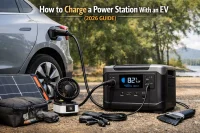



Pairing solar panels with EV charging has become one of the smartest home‑energy upgrades of 2026. With electricity prices rising and EV adoption accelerating, homeowners are looking for ways to reduce charging costs, increase energy independence, and stabilize long‑term fuel expenses. Solar‑powered EV charging delivers all three. Modern systems allow you to charge directly from solar during the day, indirectly through the grid, or through hybrid setups that include home batteries.
This guide explains how solar EV charging works, how to size your system, the difference between grid‑tied and hybrid setups, and what you need to know before pairing solar with your EV.
How Solar EV Charging Works
Solar panels generate DC electricity, which is converted into AC power by an inverter. That power can then:
Charge your EV
Power your home
Charge a home battery
Export to the grid
A 2025–2026 guide notes that pairing solar with EV charging is now the “next step” for thousands of households, offering lower fuel costs and greater resilience 1.
Three Ways to Pair Solar With EV Charging
Direct solar charging: EV charges while the sun is shining.
Solar + battery charging: Solar charges the battery; the battery charges the EV later.
Solar offset charging: Solar reduces your grid usage, lowering overall charging cost.
All three reduce reliance on grid electricity and lower charging costs.
How Many Solar Panels You Need for EV Charging
The number of panels depends on:
Daily miles driven
EV efficiency (kWh per mile)
Local solar production
Panel wattage
A 2026 guide explains that solar EV charging can eliminate most or all of your EV charging costs, making system sizing a key step in planning 3.
Typical Example
EV efficiency: 3–4 miles per kWh
Daily driving: 20–40 miles
Energy needed: 6–12 kWh/day
Solar output: ~1.5 kWh/day per panel (varies by region)
Result: Most drivers need 4–10 panels to offset daily EV charging.
Grid‑Tied vs. Hybrid vs. Off‑Grid Solar EV Charging
Grid‑Tied (Most Common)
Uses the grid as backup
Most affordable
Supports Level 2 charging easily
Works even when solar output is low
This is the setup most homeowners choose because it balances cost and reliability.
Hybrid (Solar + Battery + Grid)
Stores solar for nighttime EV charging
Reduces peak‑hour electricity costs
Provides backup power during outages
Maximizes solar self‑consumption
A 2026 accessories guide highlights that hybrid systems offer the best flexibility and resilience for EV charging 4.
Off‑Grid
Requires large battery storage
Expensive and complex
Only practical for remote locations
Level 1 vs. Level 2 Solar EV Charging
Level 1 (120V)
Slow (3–5 miles per hour)
Easy to offset with a small solar array
Works well for low‑mileage drivers
Level 2 (240V)
Fast (20–40 miles per hour)
Requires more solar capacity
Recommended for most EV households
Industry guidance emphasizes that Level 2 charging is essential for solar‑equipped homes because it aligns better with solar production windows and daily driving needs 1.
Cost Savings With Solar EV Charging
Solar EV charging dramatically reduces charging costs. A 2026 guide shows that charging an EV from the grid costs $600–$700 per year, while solar can reduce that cost to nearly zero, saving $1,500–$2,000 annually compared to gasoline 3.
Why Solar EV Charging Saves Money
Every kWh from solar avoids buying grid electricity
Solar reduces exposure to rising utility rates
Net billing/export credits are often lower than retail rates
Charging during sunny hours maximizes savings
Solar + Battery for EV Charging
Adding a home battery unlocks several advantages:
Charge your EV at night using stored solar
Avoid peak‑hour electricity rates
Maintain EV charging during outages
Increase solar self‑consumption
A hybrid system is ideal for homeowners who want maximum flexibility and resilience.
System Sizing for EV Households
Solar Array
6–12 kW for one EV
10–16 kW for two EVs
Battery Storage
10–15 kWh for basic support
20–30 kWh for heavy EV usage
30–40 kWh for whole‑home backup + EV charging
EV Charger
40A Level 2 is ideal
48A for faster turnaround or multiple drivers
Incentives & Tax Credits in 2026
Most homeowners qualify for:
30% federal tax credit on solar
30% federal tax credit on batteries
State and utility incentives
Net billing or net metering programs
These incentives significantly reduce upfront cost and improve long‑term ROI.
Final Takeaway
Solar EV charging is one of the most practical, scalable, and cost‑effective home‑energy upgrades of 2026. With the right system size, inverter setup, and charging strategy, solar can power most or all of your EV charging needs while lowering your electricity bill and increasing energy independence. Whether you choose a grid‑tied, hybrid, or solar‑plus‑battery setup, pairing solar with EV charging is a long‑term investment that pays off in comfort, savings, and resilience.